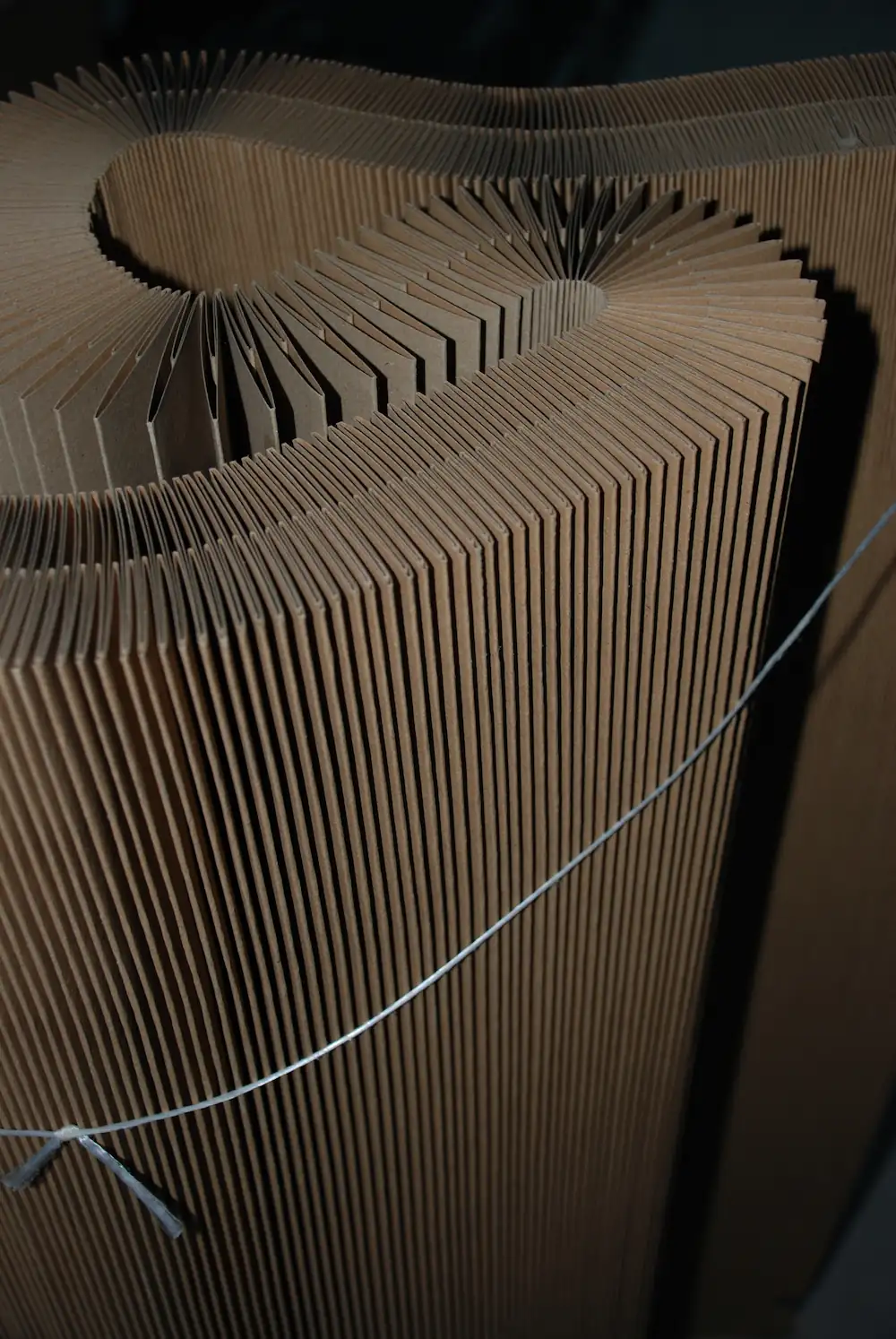


1. What is an Accordion Cardboard Filter (V-Type) and How Does It Work?
An Accordion Cardboard Filter (referred to as Andreae Filter or V-Type Pleated Paper Filter in industrial literature) is a high-performance filtration element placed on the rear suction wall of dry-type wet paint booths, featuring special V-shaped folds and asymmetrical air passage holes.
Conventional glass fiber or synthetic filters try to capture paint particles by straining them between fibers (fibrous interception). However, because wet paint particles are sticky, they quickly clog the surface and cut off airflow. The accordion cardboard filter works with a completely different physical principle: Inertial Separation / Centrifugal Effect.
How Does the Inertial Separation Mechanism Work?
- V-Pocket Air Compression: The paint-laden airflow coming from the spray gun is directed into the V-shaped pockets on the front face of the filter.
- Sudden Direction Change: When the airflow enters the pocket, it is forced to make a sharp turn close to 180 degrees.
- Impact and Trapping: Wet paint droplets (over-spray), hundreds of times heavier and denser than air, cannot adapt to this sudden turn due to their inertia. Gaining momentum, they impact the inner pockets of the filter and adhere to them.
- Uninterrupted Clean Air Exhaust: Light air purified from paint passes through offset rear holes and is directed to the exhaust fan and chimney duct.
2. Accordion Cardboard Filter Technical Details and Standard Data Table
Below are technical parameters fully compliant with purchasing specifications of industrial plants and ISO 16890 / EN 779 ventilation standards:
| Technical Feature / Parameter | Measurement / Standard Value | Industrial Description & Advantage |
|---|---|---|
| Paint Holding Efficiency | 98.1% (High Efficiency) | Maximum filtration in high viscosity and polarity paints |
| Paint Holding Capacity | 15 - 18 kg/m² | 5 times higher saturation limit compared to glass fiber filters |
| Recommended Air Velocity | 0.50 m/s - 1.00 m/s | Optimum suction and drag velocity inside the booth |
| Initial Differential Pressure (Clean Δp) | 20 Pa (at 0.75 m/s air velocity) | Puts almost zero load on the fan motor, providing energy savings |
| Recommended Final Pressure | 150 - 250 Pa | Replacement limit pressure indicating the filter is full |
| Temperature Resistance | Max. 100°C | Safe in hot applications and pre-baking lines |
| Fire Resistance Class | DIN 53438 - Class F1 / K1 | Flame retardant against solvent vapors, self-extinguishing |
| Moisture & Water Resistance | 100% Relative Humidity Resistance | Does not soften or collapse in water-based (waterborne) paints |
3. Comparative Analysis: Accordion Cardboard Filter vs. Glass Fiber Paint-Stop
A common mistake made in facilities operating dry spray booths is using floor-type glass fiber (paint-stop) filters on wall suctions. The differences between the two filters are as follows:
| Comparison Criteria | Accordion Cardboard Filter | Glass Fiber (Paint-Stop) Filter |
|---|---|---|
| Usage Area | Dry Type Vertical Suction Walls | Horizontal Floor / Under-Grid Channels |
| Paint Capacity | 18 kg/m² (Excellent) | 4 kg/m² (Clogs Quickly) |
| Airflow Stability | Constant airflow rate until full | Airflow drops sharply as paint is captured |
| Storage Volume | Foldable (Very small box volume) | Occupies high storage space in roll form |
| Waste Management & Disposal | Recyclable paper waste | Hazardous glass fiber waste class |
4. Application Areas and Industry Uses
Efe Boyahane Accordion Cardboard Filters are used as primary paint arrestors in all industrial sectors where wet paint spraying is performed:
- Wood & Furniture Industry: Lacquer, varnish, polyurethane, and enamel paint booths.
- Automotive Sub-Industry & Body Shops: Parts painting and touch-up booths.
- Metal & Plastic Injection Facilities: Industrial machinery, agricultural equipment, and plastic parts wet painting lines.
- Glass and Ceramics Industry: Surface coloring and spray coating units.
5. Step-by-Step Installation and Ideal Pleat Stretching Guide
Correct installation is essential for the filter to reach its promised 98.1% efficiency and 18 kg/m² paint holding capacity:
- Duct Measurement: Measure the net width and height of your booth suction wall. Cut the required amount from standard boxes (1m x 10m) using a utility knife.
- Pleat Stretching Ratio: After removing the filter from its box, stretch it so that there are an average of 24 - 26 pleats (folds) per meter. Over-stretching or leaving the filter too compressed like an accordion reduces separation efficiency.
- Direction Control: Ensure that the large-holed V-pockets on the front face of the filter face the spray gun (inward), and the small holes on the rear face face the exhaust fan.
- Edge Sealing: Fit the filter edges into the booth U-profiles or fixing strips without leaving any gaps. Leaking paint mist can disrupt fan balance.
6. Frequently Asked Questions (FAQ)
How often should an accordion cardboard filter be replaced?
Replacement frequency depends on the daily amount and type of paint used in the facility. However, when the differential pressure gauge (differential pressure manometer) reaches 150 - 200 Pa or suction power inside the booth visibly decreases, the filter should be replaced.
Does cardboard soften in water-based (waterborne) paints?
No. Efe Boyahane accordion filters are produced from kraft paper impregnated with special resins during manufacturing to provide water and moisture resistance. They maintain their form and strength even in 100% humid environments.
Is it mandatory to place a second filter behind the accordion filter?
The accordion filter captures 98.1% of paint particles. To capture the remaining 1.9% micro paint mist and fine dust, 100% protect the exhaust fan motor, and meet chimney emission standards, it is recommended to place a G4 cassette filter or Paint-Stop glass fiber behind it.
Do you offer custom dimensions or custom cutting?
Our standard box sizes are 1.00m x 10m, 0.90m x 10m, and 0.75m x 10m. For large project-based purchases, we have the capacity to manufacture in custom widths tailored to your booth dimensions.