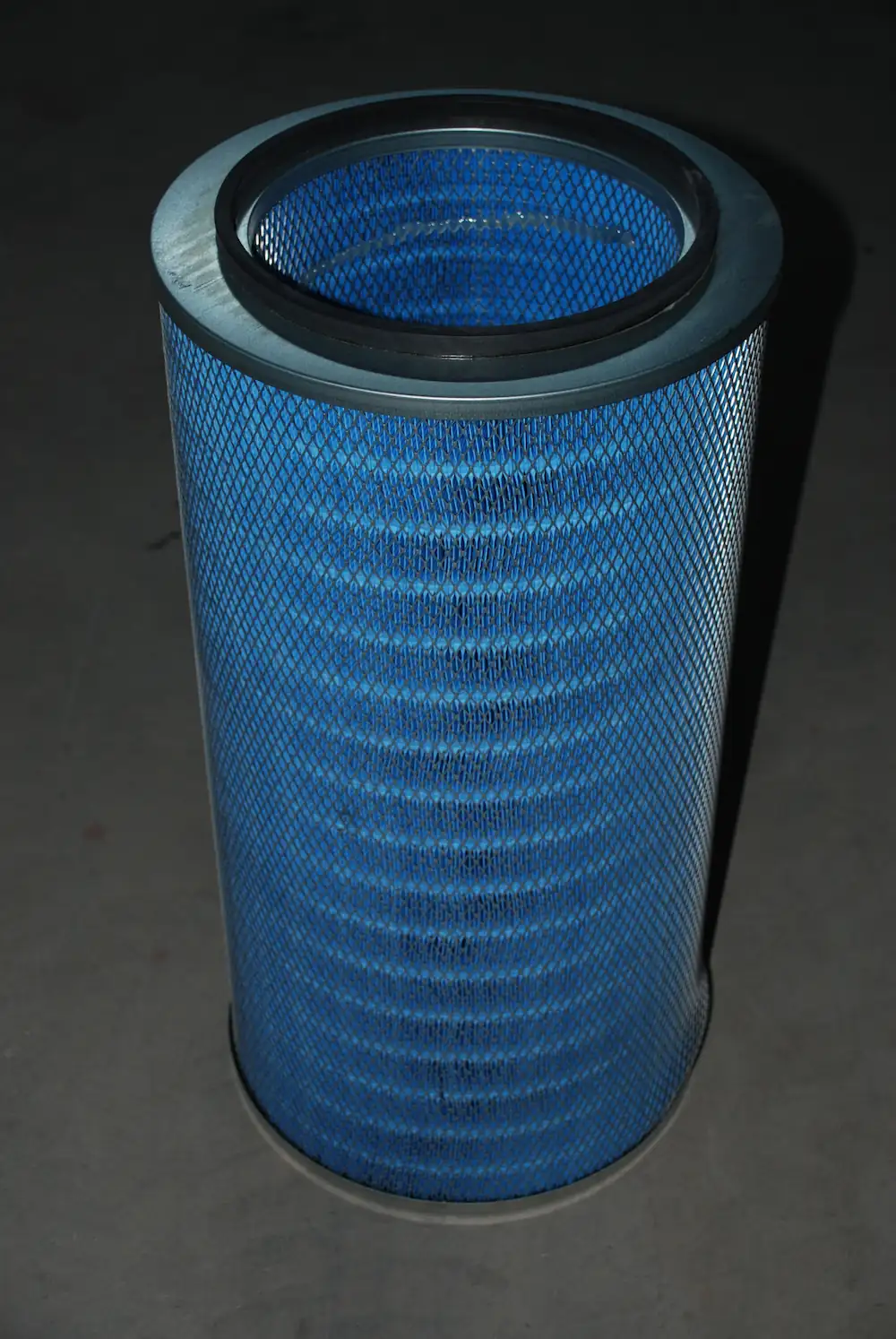


1. What is a Cartridge Filter and How Does It Work in Jet-Pulse Systems?
A Cartridge Filter is an industrial Dust Collection element that provides a massive filtration surface in a narrow space, produced by dressing high-tech filter fabric pleated (folded) in a cylindrical shape over a circular inner and outer perforated metal cage.
When the suction fan is operated in electrostatic powder coating plants or sandblasting booths, dusty air is drawn from the outside onto the surface of the cartridge filter. While dust particles are trapped in the pleat gaps on the outer surface of the filter, purified clean air passes through the cylinder inside the cartridge and is discharged into the exhaust or environment.
Jet-Pulse (Reverse Air Shock) Cleaning Mechanism
When the dust layer accumulated on the filter surface (caking) reduces air permeability, the Pulse-Valves in the system are activated. A sudden air shock at 5.5 - 6.5 bar pressure sent from the tank (within milliseconds) is blasted from the inside of the cartridge outwards in the reverse direction. This shock wave flexes the cartridge fabric, dropping all the dust accumulated on the outer surface into the lower hopper or collection bin. Thus, the filter continues to operate continuously without being removed from its place.
2. Filter Fabric Types and Industry Selection Guide
The service life and dust holding efficiency of the cartridge filter depend on selecting a fabric suitable for the chemical and physical structure of the sucked dust:
- Spunbond Polyester (Standard): Standard dust collection fabric resistant to high mechanical strength, moisture, and tearing. It is washable and reusable.
- PTFE Membrane Coated (Teflon): Sub-micron PTFE membrane is laminated onto the surface of the polyester fabric. It prevents sticky, moist, or very fine (0.2-0.5 micron) dusts from adhering to the surface. Dusts fall off easily without sticking.
- Antistatic (Aluminum Coating): The fabric surface is coated with a conductive aluminum matrix. It grounds static electricity, eliminating the risk of explosion (ATEX). Mandatory for wood, plastic, and flammable organic dusts.
- Nanofiber Coated: Produced by spraying ultra-fine fibers onto the surface. It provides high surface filtration, prevents deep clogging, and reduces Jet-Pulse cleaning needs by 40%.
3. Cartridge Filter Technical Details and Standard Data Table
Below are technical parameters fully compliant with your facility's Jet-Pulse unit and purchasing specifications:
| Technical Parameter | Measurement / Standard Value | Industrial Description & Advantage |
|---|---|---|
| Filtration Efficiency | 99.9% (ePM1 85% - ISO 16890) | Full capture of sub-micron (0.2 - 2 µm) dust particles |
| Grammage Options | 210 g/m² - 260 g/m² | Spunbond Non-woven thermally bonded polyester |
| Initial Pressure Drop (Clean Δp) | 100 - 150 Pa | Low fan energy consumption, high suction airflow rate |
| Recommended Final Pressure | 750 - 1000 Pa | Upper limit for Jet-Pulse pulsing and cartridge replacement |
| Maximum Operating Temperature | 80°C (Polyester) / 135°C (Aramid/Nomex) | Suitability for hot processes and smoke suction lines |
| End Cap Material | Galvanized Sheet / Stainless Steel / Polyurethane Cast | 100% bypass prevention with leak-proof cast gasket |
| Inner / Outer Cage | Galvanized Perforated Sheet | Non-bending body against high vacuum and Jet-Pulse shock |
4. Fields of Application and Industrial Applications
Efe Boyahane Cartridge Filters are preferred as primary filters in all industrial sectors where dust emission is high and recovering dust is targeted:
- Electrostatic Powder Coating Plants: Capturing booth paint drawn from inside the booth on filters and recovering it back to the tank over the sieve (Cyclone and Automatic Booths).
- Metal Sandblasting and Shot Blasting Facilities: Trapping heavy dusts generated by steel grit and shot.
- Laser, Plasma, and Oxy-Fuel Cutting Machine Suctions: Filtration of fine metal fumes and spark-laden dusts.
- Pharmaceutical, Food, and Chemical Plants: Active ingredient, flour, starch, detergent, and powder raw material transfer lines.
- Cement, Ceramic, and Mining Plants: Silo top filters and packaging line suction systems.
5. Connection and Cap Types (Mounting Options)
Accurate identification of the cap type is critical for your Jet-Pulse filter to fit properly into your unit:
- Three-Lug (Tri-Lobe Bayonet / 3-Lug): Easily locked into the rail system by rotating 90 degrees thanks to the 3 cast lugs on its top cap. It is the most commonly used type in powder coating booths.
- Bolt / Threaded Connection (Threaded / Center Hole): Classic system fixed by tightening the stud (threaded rod) passing through the center of the cartridge and the top nut.
- Flanged / Fit Connection (DIN Flange): Model with a metal flange containing 3 or 4 holes on its top cap, connected directly to the plate with bolts through the holes.
6. Frequently Asked Questions (FAQ)
When should a cartridge filter be replaced?
If the differential pressure gauge (differential pressure manometer) remains continuously at 750 Pa and above despite the Jet-Pulse pulse pressure, it means the pores of the filter fabric are deeply filled and need to be replaced with a new one.
How is the cartridge filter cleaned while changing paint color in a powder coating booth?
During color changes, filters should be cleaned from the outside in with a manual air gun while inside the unit, or PTFE membrane cartridges that allow fast color changes should be preferred. Since paint does not stick to membrane filters, color transition time drops down to 5 minutes.
How should the washing process of cartridge filters be performed?
Spunbond polyester cartridges can be washed with neutral detergent and warm unpressurized water. After washing, filters should not be installed in the system **until they are completely dry**. Dust adheres to wet-installed filters, turns into concrete, and renders the filter unusable.
Do you manufacture cartridge filters based on samples or custom dimensions?
Yes. As Efe Boyahane, we manufacture exact dimensional replacements by examining the diameter, length, and cap details of your existing damaged or old filter.