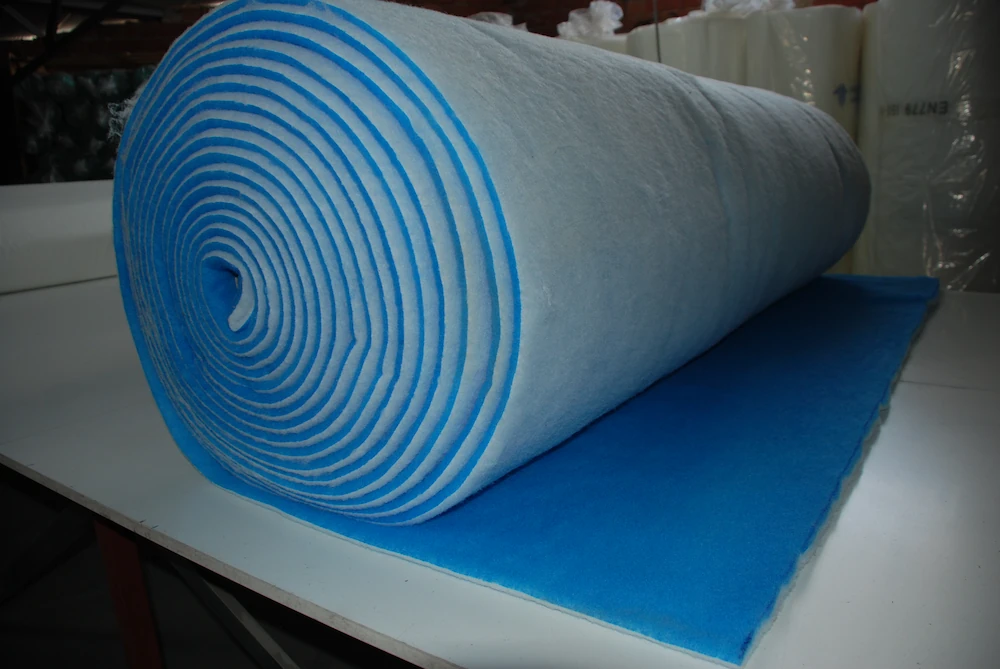


1. What is a Pre-Filter and Its Critical Role in Ventilation Systems?
Pre-Filter is a primary stage (first stage) filtration element used to strain coarse particles in air handling units, air conditioning lines, spray booth fresh air intake units, and industrial suction systems.
Atmospheric air drawn into a facility or conditioned space contains dense amounts of sand, dust, pollen, leaves, textile fibers, and insect particles. When these coarse contaminants directly reach fine filter stages (F7, F9, HEPA) or heat exchanger coils, they cause rapid clogging and high energy consumption. Pre-filters absorb nearly 90% of this load, preserving the overall efficiency of the system.
2. Types of Pre-Filters and Structural Characteristics
Depending on your facility's operating environment and air quality requirements, the types of pre-filters you can choose include:
- Synthetic Polyester Fiber Pre-Filters (G2, G3, G4): Feature a progressive fiber structure bonded thermally. Thanks to its density that tightens toward the direction of airflow, it stores dust deep within the media rather than just on the surface. Economical with high dust holding capacity.
- Washable Polyurethane Foam Pre-Filters (PPI): Produced from porous (reticulated) polyurethane foam. Can be washed with water and mild detergent for repeated use. Preferred in devices requiring low pressure drop and moisture resistance.
- Stainless / Galvanized Metal Mesh Pre-Filters: Consist of layered aluminum or galvanized mesh wire. Used as a washable pre-filter in industrial kitchens and foundry suction lines exposed to high temperatures, oily vapor, and moisture.
3. Pre-Filter Technical Data Table (EN 779 & ISO 16890 Standards)
Below are technical parameters compliant with your system design and procurement technical specifications:
| Technical Parameter | G2 Pre-Filter | G3 Pre-Filter | G4 Pre-Filter |
|---|---|---|---|
| ISO 16890 Equivalent | ISO Coarse 30% | ISO Coarse 50% | ISO Coarse 65% - 85% |
| Average Dust Capture (Arrestance) | 65% - 80% | 80% - 90% | 90% - 95% |
| Weight / Grammage | 100 - 150 g/m² | 180 - 220 g/m² | 250 - 350 g/m² |
| Material Thickness | 8 - 10 mm | 12 - 15 mm | 18 - 22 mm |
| Initial Pressure Drop (Clean Δp) | 15 - 25 Pa | 25 - 35 Pa | 35 - 50 Pa |
| Recommended Final Pressure Drop | 200 Pa | 250 Pa | 250 Pa |
| Flame Retardancy | DIN 53438 (F1) | DIN 53438 (F1) | DIN 53438 (F1) |
4. Areas of Use and Sectoral Applications
Efe Boyahane Pre-Filters serve as the first line of defense in all air conditioning and manufacturing processes where clean air is critical:
- Wet Spray Booths and Fresh Air Units: Filtering coarse dust in air entering the spray booth to supply clean air to the sensitive space below the ceiling (ceiling filter).
- HVAC Air Handling Units: Coarse filtration in air handling units of shopping malls, hospitals, hotels, and factories.
- Compressor and Fan Suction Lines: Preventing dust from entering industrial compressors and air blowers.
- Air Conditioning and HVAC Plants: Preventing heat exchanger coils and fan blades from becoming coated in dust, which reduces heat transfer efficiency.
5. Pre-Filter Maintenance and Replacement Time Detection
To ensure your pre-filter reduces operating costs without straining fan motors, pay attention to these 3 rules:
- Differential Pressure Monitoring: The differential pressure gauge in the filter cell should be monitored; when the pressure drop reaches 4-5 times the initial value (approximately 250 Pa), the filter should be replaced.
- Visual Inspection and Clogging: When excessive dust accumulation or discoloration (soiling) occurs on the fiber surface, intervention should take place before airflow rate drops.
- Roll and Panel Replacement: When installing cut panel media into frames, they must be placed with complete sealing to prevent air bypass (leakage) around the edges.
6. Frequently Asked Questions (FAQ)
What is the main difference between a G4 pre-filter and an F7 fine filter?
A G4 pre-filter is a primary filter designed to capture coarse dust particles (10 microns and above). An F7 fine filter is a secondary-stage filter that strains fine dust (1-3 microns) and small particles harmful to human health. The G4 filter is placed ahead of the F7 filter to prevent it from clogging early.
Can I purchase in full rolls or as cut-to-size panels?
As Efe Boyahane, you can obtain our pre-filters in standard 1m x 20m or 2m x 20m rolls, or as cut panels tailored to the custom dimensions of your ventilation cassettes or suction panels.
Which class of pre-filter should be preferred in a spray booth fresh air unit?
In fresh air intake lines that directly affect painting quality, it is recommended to use at least a G4 (250 g/m²) high-grammage synthetic fiber pre-filter.